Between quotes, invoices, inventory, emails, customer follow-ups, and Excel files... many businesses end up working with a dozen different tools that do not communicate with each other.
Results:
- Time loss,
- manual errors,
- scattered information,
- less efficient teams.
This is exactly the problem that Odoo aims to solve.
And contrary to what is often imagined, it is not necessary to be a developer or 'technical' to understand how an ERP works.
In this guide, we will explain Odoo simply, with concrete examples and without complicated jargon.
Odoo in a few numbers
Today, Odoo is used by more than 15 million users worldwide.
The tool is used by:
- SMEs,
- e-commerce businesses,
- service companies,
- manufacturers,
- and even large international groups.
Why are so many companies switching to Odoo?
Because it allows you to manage almost an entire business on a single platform:
- CRM,
- sales,
- accounting,
- inventory,
- HR,
- e-commerce,
- marketing,
- customer service,
- projects,
- production,
- etc.
In summary: Odoo acts as the "control center" of the company.
What exactly is Odoo?
Imagine your business as a house. In many companies, each room operates separately:
- the sales team works in their tool,
- accounting in another,
- inventory elsewhere,
- and the manager receives incomplete information.
Odoo connects all the pieces together. Specifically, Odoo is an ERP. (ERP stands for: Enterprise Resource Planning)
But simply put: a software that centralizes all the management of a company.
Instead of using:
- invoicing software,
- a CRM,
- inventory tools,
- HR software,
- a separate e-commerce…
…everything works together on a single platform.
Why do companies love Odoo so much?
1. Everything is connected
Example:
A customer places an order on the site:
- the inventory updates,
- the invoice is generated,
- accounting retrieves the information,
- the sales team sees the customer history.
Without copy-pasting.
Without double entry.
Without Excel.
2. Odoo is modular
Odoo works like a smartphone:
you only install the applications you need.
A company can start with:
- CRM,
- sales,
- invoicing.
Then add later:
- inventory,
- e-commerce,
- HR,
- marketing,
- customer service,
- production,
- etc.
3. The interface is more modern than many ERPs.
For a long time, ERPs had a reputation for being:
- complicated,
- outdated,
- difficult to use.
Odoo has gained a lot of popularity because its interface is simpler and more modern than many traditional legacy ERPs.
Odoo modules explained simply
| Module | What it's for | Concrete example |
|---|---|---|
| CRM | Manage leads | Track business opportunities |
| Sales | Quotes & orders | Send a quote quickly |
| Invoicing | Manage invoices | Automatically follow up on unpaid invoices |
| Accounting | Financial management | VAT, entries, balance sheet |
| Inventory | Product management | See quantities in real time |
| E-commerce | Online store | Sell directly on your site |
| HR | Employee Management | Leave & Absences |
| Project | Task Organization | Team Tracking |
| Customer Service | Customer Support | Tickets & Assistance |
| Marketing | Emailing | Automated Campaigns |
Simple Diagram: How Odoo Connects the Entire Company
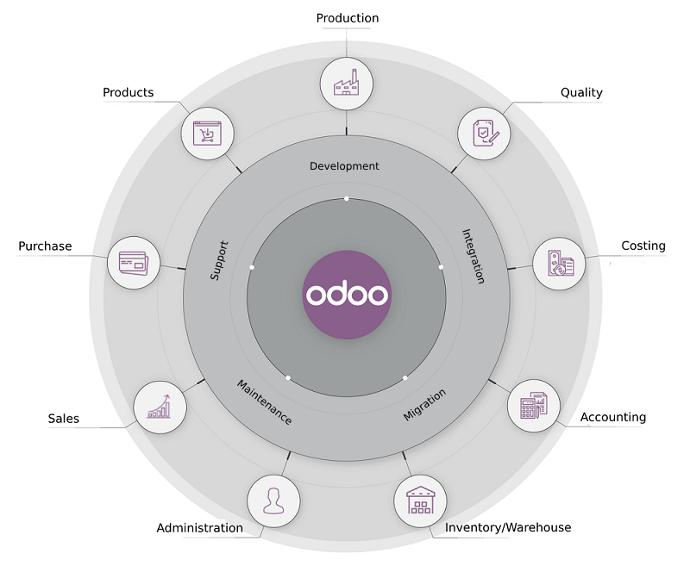
Here is a very simple example:
- A salesperson creates a quote
- The customer validates the order
- The stock prepares the product
- The invoice is generated automatically
- Accounting retrieves the data
- The manager sees everything in their reports
Each department works with the same information.
Is Odoo free or paid?
The short answer: both.
Odoo Community is available in a free version.
Odoo Enterprise is available in a paid version with more features.
Odoo Community vs Enterprise Table
| Function | Community | Enterprise |
|---|---|---|
| Free | ✅ | ❌ |
| Open source | ✅ | Partially |
| CRM | ✅ | ✅ |
| Sales | ✅ | ✅ |
| Advanced Accounting | Limited | ✅ |
| Automations | Basic | Advanced |
| Official Support | ❌ | ✅ |
| Odoo Hosting | ❌ | ✅ |
| Studio (Customization) | ❌ | ✅ |
| Advanced Mobile Interface | Basic | Complete |
How much does Odoo really cost?
The price mainly depends on:
- the number of users,
- the installed modules,
- the customizations,
- and the support.
Small business
If you have:
- few users,
- few modules,
- low complexity,
... the budget can remain reasonable.
More advanced ERP project
The cost mainly increases when you add:
- complex automations,
- custom developments,
- external connectors,
- specific workflows,
- multi-company,
- advanced production.
The classic trap: wanting to automate everything immediately. The best ERP projects often start simply.
The benefits of Odoo
1
Time savings
Fewer manual tasks.
2
Better visibility
All data is centralized.
3
Scalability
The company can gradually add modules.
4
Fewer separate tools
Odoo can replace several different software.
The limits of Odoo
To be honest, Odoo is not magic.
You need to structure your project well
-> Poor configuration can complicate things.
Too much customization can become problematic
-> Some companies want to recreate their old habits exactly.
This is often a mistake.
An ERP requires support
-> Even with a good interface, an ERP remains a true business project.
Where to start with Odoo?
Step 1: identify the real problems
Ask yourself these questions:
- Where are we losing the most time?
- Which tools do not communicate?
- Where are there repetitive errors?
- Which processes are too manual?
Step 2: start small
Most companies start with:
- CRM
- Sales
- Invoicing
Then gradually add the rest.
Step 3: avoid "fully customized"
The more an ERP is customized to the extreme:
- the more expensive it becomes,
- the more complex it becomes,
- the harder it is to maintain.
Frequently asked questions about Odoo
Yes. Many SMEs use Odoo precisely because it is modular and scalable.
No. The interface is designed for non-technical users.
Yes. This is even one of its main objectives.
Yes. Odoo has its own e-commerce module and can also connect to other platforms.
It depends on the complexity of the project.
A small deployment can be quick, while a complete ERP can take several months.
No. Odoo is used by both small organizations and larger companies.
Conclusion
Odoo has become one of the most popular ERPs in the world because it combines:
- modularity,
- simplicity,
- automation,
- and centralization.
The most important thing is not to have a "perfect" ERP.
The most important thing is to have:
- a clear system,
- simple processes,
- and tools that save your team time.
Book a free discovery demo
Do you want to see concretely:
- which modules are useful for your business,
- how Odoo can simplify your processes,
- and where to start without complicating your business?
Book a free discovery demo and let's discuss your ERP project.